

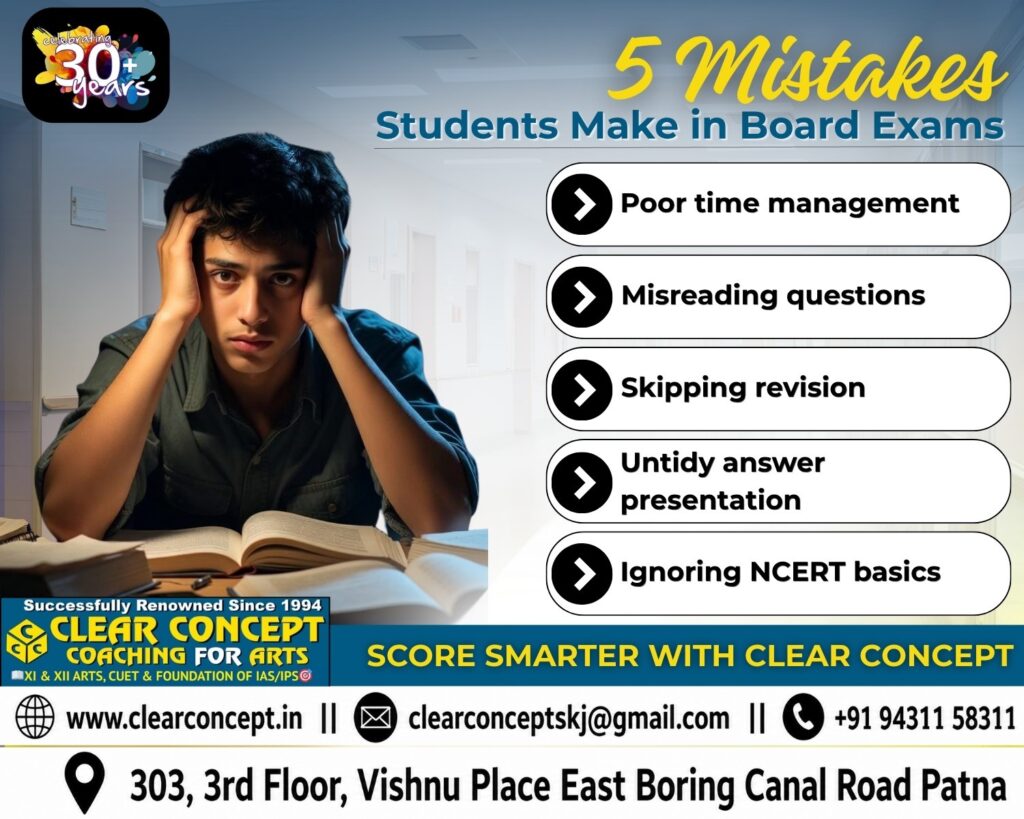
Board examinations play a crucial role in shaping a student’s academic future. While many students study hard throughout the year, they often lose valuable marks because of common mistakes made during the examination. Understanding these mistakes and learning how to avoid them can significantly improve performance and scores.
1. Poor Time Management
One of the biggest reasons students fail to complete their papers is poor time management. Many students spend too much time on difficult questions and are left rushing through the remaining sections.
To avoid this mistake, students should practice solving sample papers within the prescribed time limit. Allocating specific time slots to each section helps ensure that all questions receive adequate attention during the examination.
2. Misreading Questions
A common mistake in board exams is reading questions too quickly and misunderstanding what is being asked. As a result, students may write partially correct answers that do not fully address the question.
Students should carefully read every question, identify important keywords, and understand whether the examiner is asking for an explanation, comparison, definition, or analysis before beginning the answer.
3. Skipping Revision
Many students use the entire examination duration for writing and leave no time for revision. This often results in unnoticed spelling mistakes, incomplete answers, incorrect numbering, and calculation errors.
Keeping the last 10–15 minutes for revision can help students identify and correct mistakes before submitting their answer sheets.
4. Untidy Answer Presentation
Even a well-prepared answer can lose its impact if it is presented poorly. Untidy handwriting, overcrowded paragraphs, improper headings, and excessive cutting can make answers difficult for examiners to evaluate.
Students should maintain neat handwriting, use proper headings and subheadings, leave adequate spacing, and underline important points where appropriate. Good presentation creates a positive impression and enhances readability.
5. Ignoring NCERT Basics
Many students focus heavily on guidebooks and reference materials while neglecting NCERT textbooks. However, a significant portion of board examination questions are based directly on NCERT concepts and fundamentals.
A strong understanding of NCERT chapters, definitions, examples, and exercises helps students build a solid foundation and answer questions with confidence.
Conclusion
Success in board examinations is not only about studying hard but also about avoiding common mistakes. Proper time management, careful reading of questions, regular revision, neat presentation, and strong NCERT fundamentals can help students maximize their scores.
At Clear Concept – Best Arts Coaching in Patna, students receive expert guidance, regular tests, answer-writing practice, and personalized mentorship to help them avoid these mistakes and perform their best in board examinations.
Score Smarter with Clear Concept – Best Arts Coaching in Patna
Join Clear Concept and learn the strategies, techniques, and concepts that lead to academic success.